Thursday, September 22, 2011

Have some fun with new books to make it easier to get through that evil word.

What a week!  It just seems like crazy things keep happening and I still have this homework to do.  It somehow just never really goes away!  I know it’ll all be worth it when I get the degree.
While checking out the new posts on LM_NET I found some very interesting ones on September 19.   One included hints and tips for maintaining consistency in the cataloging.  From reading it sounds like keeping consistency in the cataloging can be as much of a challenge for librarians as it was for me when I took cataloging.  Some librarians will leave a manual for the next librarian which I hope I’m lucky enough to find when I get a library position.  The post originated from Molly Smith a student in SLM.  Another posting I found was from Victoria Blackshear looking for lesson plans for middle school library media specialists.  Some of the lesson plans and websites suggested would be useful to bookmark.  I even saw a couple of resources I’ve used before such as Kathy Schrock’s Guide for Educators and Read-Write-Think.  Other links were new to me and had some good information.  The third and possibly most interesting post I found was one detailing the new features of Facebook and a tool which can be used to hack Facebook profiles which was posted by Gary Price.  This is information which everyone needs to know, not just librarians.  I have included the link for the article about the hacking tool for Facebook:   http://www.securitynewsdaily.com/facebook-hacking-tool-clones-friends-steals-profiles--1152/
From the LM_NET I went on to reading a few blogs.  The first blog entry I read was the blog entry from “A Chair, A Fireplace & A Tea Cozy” by Liz B posted on September 21st.  The subject of the blog was the amount of LGBT characters in YA books.  A pair of authors made the claim an agent offered to sign them if they would remove the sexual orientation of a gay character.  Of course the publisher has a different view, but less than one percent of young adult books published have LGBT characters.  While this is an uncomfortable topic for many people, librarians should be open enough to realize there is a niche for literature with LGBT characters. 
Next I checked out what was new on the blog “The Cloud Reads – Adult Books 4 Teens.”  The most recently reviewed book was entitled Secrets of the Wolves by Angela Carstensen, posted on September 22.  This book sounds very interesting in that it is written completely from the point of view of a wolf.  The author did an intense amount of research to make this as realistic as possible.  I’m very curious to see how the book plays out.  I was also interested to note that the book would even be suitable for younger, middle school age readers.  It’s not often you find a book written for adults which can be also appropriate for middle school students. 
To found out my blogs for the week I stopped on the blog “NeverEndingSearch.”  The entry for September 22 was very intriguing.  It’s promoting a new website www.readit1st.com.  The website promotes reading the book before watching the movie as often as possible.  I found one statistic very interesting in that 5 of the top 10 movies of 2010 were based on movies.  It really does seem like more and more books are made into movies.  I’m always ready to compare the book and movie and hope the movie is not lacking.  Seldom do I actually like the movie more than the book.  There are movies I refuse to watch after one viewing because of how much they ruined the story when it became a movie.  I was amused to see the vlog of the creator of Readit1st.  He seems to think very quickly, but I definitely like the idea of reading the book before watching the movie whenever possible.
I can’t help but love the podcast “Books on the Nightstand.”  It’s such fun to hear about all of the books coming out and hearing reviews and tips.  The posting from September 20 had a huge list of graphic novels for the newbie to graphic novels.  This is a format I have very little experience with.  I keep telling myself to read more, but part of me feels like it’s cheating.  I realize graphic novels are a very legitimate piece of literature and it is not cheating to read one instead of a more traditional book.  There are some amazing sounding graphic novels out there and one of these days I really will check one out of the library.  Of course there is Maus which is about WWII and has cats as the Nazi’s and mice as the Jewish which is an ever popular point of discussion with a couple of my classes.  In the extensive list given I did find a couple that I plan to look for the next time I go to the library such as the series Fables about what would happen if fairy tales and fables came to life and Camelot 3000 which is set in the future and Merlin and Arthur have come back and fight to protect earth from aliens. 
Graphic novels were not the only topic of the podcast, I actually first chose it to find out what classic children’s books were turning 50.  I think the book on the list that shocked me the most was A Wrinkle in Time.  I had just never realized that book was quite that old.  All 4 of the books listed to bring back memories such as The Phantom Tollbooth, A Snowy Day and James and the Giant Peach.  Each book I read while a child.  I also remember the movie for James and the Giant Peach. 
Other books talked about in the blog were The Night Circus and Just My Type.  The entire time I was listening to the review and summary of The Night Circus I couldn’t help but think about Water for Elephants.  The only reason for the comparison was that they both take place in a circus.  Just My Type sounds like the perfect book for a graphic design nerd.  Not that there’s anything wrong with being a nerd of any sort, the book is about fonts and how they are created and used, and why some are used more than others.  Not something just anyone would pick up.   
Budgets:  What a fun topic.  I put this off till last because some of my students think it’s an evil word in Personal Finance.  Well, budgeting is an ever present word with the economy being the way it is.  It is not just the library that has to worry about budget.  Empowering Learners promotes finding creative ways to make the budget stretch like using free web-based applications and open source software.  It also points out the necessity of keeping the administration in the loop on what is occurring in the library so the importance is not forgotten in the shuffle.
At the very beginning of the chapter Wools points out that the amount of money allocated to the library affects if the library will survive or disappear.  The library is competing with teachers, sports and other school organizations for funding.  Some states mandate a minimum which can be spent in the library and that makes it more difficult for librarians to have an impact on what money they get.  It is important to know what the fiscal year for the district is so all materials can be purchased by the correct date.  To enlarge the program often a librarian must write a proposal to expand the library in some way.  The proposal could contain a statement of needs, goals, objectives, plan of action, an evaluation plan, information about facilities and other resources available.  It is important to be detailed when writing the proposal.  Budget is a key component of the plan.  Often if a program is approved comes down to dollars, how much will it cost?  When costs are too high often a program is cut back or not approved at all.  Oh, the joys of a budget.
Whew, what a week.  There was some fun stuff like new books to read.  Scary stuff such as the ability to hack Facebook so easily.  Then came the depressing thoughts of budgets.  That evil, bad word we all must face in the library media center and our own lives.

Thursday, September 8, 2011

A Book Review and More

How has education changed seems to be a small thread running through my selections for this week.  From a podcast about becoming global citizens and a comparison of the education system to the manufacturing system it’s been a thoughtful week.
To start off with reading some of the LM_NET postings I found one I was surprised to see.  Michelle Levy had posted to the listserve looking for ideas for teaching Keyboarding to Middle School students (9/7).  I was surprised to see this come across my librarian listserve.  I’m used to seeing Keyboarding ideas coming across the business teacher listserve I belong to – but I expect it there.  Looking through the list I did see a couple of resources to save for when I need to work on keyboarding skills with my students. 
Next I read a list of resources for teaching about 9/11 posted by Linda Slacum (8/31).  This is such a big topic with the 10th anniversary of that date coming up so soon.  We were having a discussion at lunch today actually about what we remembered from that day.  All of the teachers can remember what it felt like and was to see and realize exactly what had happened that day.  Our students today have no clue – while they may have been alive on 9/11/2001, they were not old enough to really remember the day.    Because of this lack of knowledge it is important we teach kids what happened that day and how the world reacted. 
Then finally I came across a posting by Heidi Lewis which contained a list of Dystopian books similar to Hunger Games and Uglies (8/31) I have always liked Dystopian books and so do many of our high school students.  It handy to have a list put together right there on similar books.  It is good to see that many of the books are already in my school’s library.
How do you raise successful global citizens was the topic of a very thought provoking podcast I found.  The podcast was Bit by Bit: Show 125 from August 23, 2011 by Bob Sprankle.  In fact after an introduction this podcast is the recording of a discussion on the topic from the previous day with author Homa Sabet Tavangar, the author of Growing Up Global.  The focus was about everyone having a story which connects to the world.  No matter if you never leave the city you were born in, somehow with today’s society you are connected to the world.  Kids play video games with other kids from another country, it’s as easy as typing some words to find someone to chat with online.  Somehow we need to teach our children how very Global our society has become.  Again there was a connection to how society has changed our connection to the world since 9/11.  Just the act of flying someplace is radically different – body scans and taking off shoes.  One line from the podcast really stood out to me though:  “you can build the walls, but you can’t keep ideas out.”  This is so true – countries try to build walls and keep ideas out, but in this global society it is impossible.  Look at the revolutions which have been told in real-time through the use of mediums such as Facebook and Twitter.  The podcast really made me think about how you need to take a larger view than just yourself, we all leave a mark on the global society.
The blog A Chair, A Fireplace & A Tea Cozy had a review written by Liz B. posted on 9/8/2011 of the book The Girl of Fire and Thorns.  After reading the review I’m really intrigued by the book.  I want to know more about Elise, the girl who is a princess and chosen.  This has provided her with a privileged existence to this point.  The book has strong themes of taking responsibility for ones actions and a healthy respect of religion.
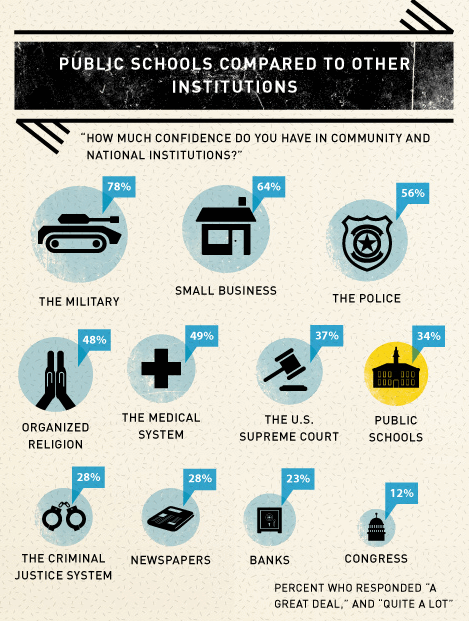
The next two blogs I read can be looked at together.  The blog 2 cents Worth by David Warlick on 9/8 entitled “We Don’t Trust What We Can’t See . . .” and Doug Johnson’s Blue Skunk Blog posted on 9/7/2011 entitled “Mass Customization in Education” have a similar theme.  David Warlick approaches the topic of the decline in confidence of the education system.  When public schools are compare with other groups they come in 6th in confidence level.   Warlick’s theory is that we trust what we can see, we can see the military presence and our doctors, but it is more difficult to see the face of education.  Maybe the inability to see the face of education has something to do with Doug Johnson’s blog entry about customizing education.  Seth Godin and Ken Robinson believe the model we use to teach students is too industrial; they believe all children should have individualized education.  Johnson’s argument is that individualized education for all students would be ideal but is not an economic reality.  The individualized education of all students would be extremely costly and is not feasible.  This is not to say every teacher just ignores creativity and just teaches by route.  We are encouraged to use differentiated instruction, but with a room of 25 students, you can only differentiate so much.  So perhaps if Godin and Robinson were listened to and education became individualized for each and every student the confidence in the education system would increase because the shortage of teachers we already have would just multiply.

Saturday, August 27, 2011

From Copyright to Interviews

A whole world of knowledge can be found online if you just know where to look.  For example you can find others searching for the same answers to copyright questions you may have, find librarians debating the use of Kindle’s in the library, get ideas to prove that you as a LMS are vital to the school, find an untold number of book reviews, interviews with authors and much more.
When looking at the LM_NET postings I found a few of interest.  The first one was from Becky Schallar and it was a copyright question, specifically student use of images found online.  This is of particular interest to me as a Desktop Publishing teacher. The final consensus was images found online may be used in an educational setting as long as there is a limited audience and proper citation.  For example my students could use photographs found online for their travel brochures as long as they have proper citations because only myself and their classmates will see the work.  If anything is to be posted online or distributed we would need to get permission from the author. 
The second point of interest was Carol Van Brocklin, a librarian in the Philippines who is questioning  the use of Kindle’s in the library.  So far there had been no responses to Van Brocklin’s question but she shared what information she had found out.  Amazon is talking about going to a 1:1 ratio of one Kindle to one account which means books could not be shared among devices.  She did find that right now though it is still 1:6 so one account can be attached to six Kindles. 
Finally I found a posting by Toni Koontz.   In this posting she gives ideas for staying organized and keeping track of all that is done as a Library Media Specialist throughout the school year so a through end of the year report can be given to the principal.
Moving on to a different type of knowledge I went to reading blogs.  The first blog I read was Adult Books 4 Teens.  This is something I would have been interested in when I was younger because sometimes teen books were written below my reading level so I found them boring.  Just checking back over the entries for the end of the week was enlightening.  One book was about sexual exploitation in the US, another was hugely science fiction and the third was a graphic novel about eating disorders.  Lucille by Ludovic Debeurme is the graphic novel in question.  I had never considered how a graphic novel about a subject such as eating disorders could be so impactful.  With the graphic novel readers are forced to see the damage to a person’s body an eating disorder can cause.
From there I switched gears and looked at the ALA TechSource blog and read up on their opinion of what Smartphone internet usage means for libraries.  The first point is libraries must make sure their webpages are compatible with Smartphones.  The second is libraries need to prove they provide the only access to high speed internet for many people.  I know from experience if I want to get on the internet when I visit my parents I have to make my dad take me to his work after hours or go to the library since my parents can only get dial-up internet at home.  After so much time spent with high speed I just cannot do dial-up anymore!
Next I went to read Doug Johnson’s Blue Skunk Blog and today’s entry made me smile.  He was talking about the changing mindset of librarians and teachers entering those fields.  Some of his points I had to add my own opinion to.   Under the “Librarian’s entering the field today” heading with number 1, I have never typed a catalog card but do still remember learning how to use one and thinking they were cool back in elementary school.  Going to 6, I will never purchase filmstrips, but will still have the fond memories of them in my 8th grade history class (mind you this was in 1998-1999 so they were pretty old even then).  Then my personal favorite on his librarians list is 8, I will never check out the floppy disks of games but I still maintain Where in the World is Carmen Sandiego and Oregon Trail were the best games ever.  Now when it comes to his list “Teachers entering the profession”  I heartily disagree with his points 2 and 7.  Number 2 says these teachers will never keep a paper gradebook, my school still requires a hardcopy along with the online grades in case something happens.  Then number 7 says all teachers have a phone and voicemail in their classroom.  I think there are 4 teachers in the building with a phone in their classroom.
When choosing podcasts to listen to (I really wanted to listen to the Teen Podcast from Seattle Public Libraries entitled “Harry and the Potters” which was teens playing music inspired by the Harry Potter books, but I wasn’t sure if it qualified as educational) I decided to go for the NPR:  Books Podcast entitled “New Teen Novels, Terry Pratchett, Vampires, Werewolves and More dated August 18, 2011 and the Books on the Night Stand (BOTNS)  episode 143 dated August 23, 2011.  Both podcasts contained some book reviews. 
The BOTNS began with an interesting innovation coming from a small publisher, Melville House Publishing, the hybrid book.  This publisher is publishing books with a QR code (those square symbols you scan with your Smartphone) which takes the reader to “illuminations” which help fill in the backstory of the plot.  It is likened to DVD extras for a book.  Following this several new to paperback books were introduced one of which The Language of Flowers was also talked about in the Adult Books 4 Teens blog.
The NPR podcast began with 5 new young adult books worth reading either as a teen or even an adult.  They included:
·         Flip by Martin Bedford
·         Delirium by Lauren Oliver
·         10 Miles Past Normal by Francis O’Roark Dowell
·         Trapped by Michael Northup
·         Karma by Cathy Ostlere
This section was followed by an interview with Terry Pratchett discussing his views on doctor assisted suicide, a review of The Family Fang (also included in the Adult Books for Teens) an interview with the author of Thick as Thieves and an interview with a close friend of LA Banks who recently passed away from cancer.  This was probably my favorite part because I had read some of her books and enjoyed them.  She was writing about vampires and werewolves before the days of Twilight and True Blood.